
Mapping the House: Redistricting in the United States
If you have ever questioned the value of one vote, a study of the fight for fair voting maps in America provides assurance. The history is as labyrinthian as the gerrymandered maps, and battles still rage. So, what are we fighting for?
One way the U.S. could operate as a constitutional republic with democratic principles is by upholding equitable maps to its citizens. In most other democratic countries, independent commissions decide voting district boundaries. In the U.S., ethical challenges surface in states where redistricting maps are drawn by partisan actors, and gerrymandering corrodes fair elections. With an increase in midcycle gerrymandering, Mormon Women for Ethical Government has prioritized advocacy toward equitable voting access.
“Political structures and electoral systems should be designed to maximize participation of and provide equitable access to all citizens in a society.”
Redistricting terms to know
The subject of redistricting introduces unique terms. The following list scaffolds the terms in an order helpful for understanding the topic.
Reapportionment: Process of reallotting the 435 fixed seats in the U.S. House of Representatives after each census on the basis of population.
Example: After the 2020 census, Texas gained two seats; Colorado, Florida, Oregon, Montana, and North Carolina gained one seat each; and California, Illinois, Michigan, New York, Ohio, Pennsylvania, and West Virginia each lost one seat.
Voting district: Areas created by state and local governments to administer elections.
Example: In 2026, the New York City Council is divided into 10 voting districts that govern more than 1,585,000 people who live in an area approximately 13.5 miles long and 2.4 miles wide.
Redistricting: Redrawing of election districts.
Example: In 2018, Utah voters approved Proposition 4, which appointed a redistricting commission to redraw previously gerrymandered maps.
Vote dilution: Umbrella term for any electoral practices that weaken the voting power of one or more groups.
Gerrymandering: Broad term for mapping district boundaries in ways designed to favor particular electoral outcomes.
Partisan gerrymandering: Mapping district boundaries to benefit one particular party or harm one another.
Example: In 2025, California gerrymandered its maps to potentially add five more Democratic districts and to offset Republican gerrymandering in Texas.
Cracking: Splitting a targeted group of people into multiple districts to dilute their collective voting power.
Example: In 2025, Texas Republicans cracked the previously blue District 32, splitting up several Dallas suburbs to result in a new red voting district.
Packing: Lumping a targeted group into minimal districts to weaken votes everywhere else.
Example: In Texas in 2025, the legislature packed Democrats in the city of Houston into one district, so Republicans would outnumber them in all the other districts.
Racial gerrymandering: Mapping to “increase or decrease the influence” of a racial group.
Example: Democrats and Republicans in North Carolina have infamously battled control of their House seats since 1990, drawing maps that favor and disfavor Black voters.
Incumbent protection: Mapping to protect current office holders.
Example: When Connecticut lost six of its House seats after the 2000 census, new maps were drawn to allow incumbent representatives in both major parties chances to continue.
Redistricting highlights in history
1790: Enumeration
The framers of the Constitution envisioned a government where voters from every state were fairly represented in Congress by the process of “enumeration,” or being counted. Article I, Section 2 established the apportionment of representatives through redistricting, and this has occurred every decade after each decennial census.
1812: Gerrymandering
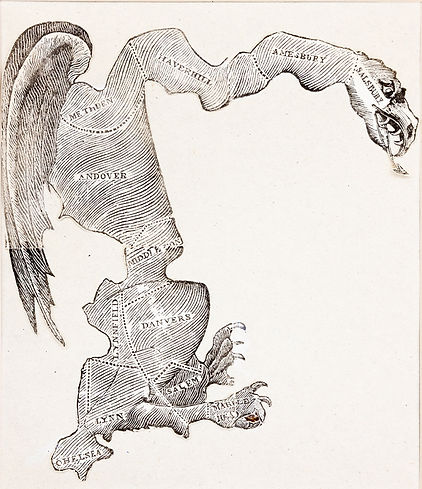
In the summer of 1812, a political cartoonist at the Boston Gazette depicted the disordered boundaries for Massachusetts state Senate election districts as a “mythical salamander.” Democratic-Republicans concocted the map in favor of their party, and, though he disagreed with it, Governor Elbridge Gerry acquiesced to his party and signed the bill. The Gazette coined the term for this manipulation of boundaries “Gerry-mandering,” and it stuck.
1842: Apportionment
Until 1842, the choice of number of representatives varied throughout the states. The size of the House of Representatives became a hotly debated topic during the legislative session and resulted in the passing of the Apportionment Act. The new law mandated single-member districts, meaning voters cast one vote for a candidate to represent the people of his smaller geographic district. The new law shrunk the House at the time and ended general ticket voting, or voting for several candidates to represent the state. It would take until 1967 for the concept of single-member districts to become permanent and not up for debate and renewal every 10 years.
1920s: Paused redistricting and permanent apportionment
The census of 1920 revealed that the U.S. population was more urban than rural for the first time in its history, and the House was growing exponentially in seats. Debates over how to handle this shift overshadowed any redistricting until 1929, before the next census. Then, in 1929, Congress passed the Permanent Apportionment Act, which capped the House of Representatives at its current number of 435 members. This same number has held through today.
Supreme Court impacts
The Supreme Court recently addressed two specific types of gerrymandering. The first is partisan gerrymandering. In Rucho v. Common Cause, the court held that claims of partisan gerrymandering present political questions that are beyond the reach of federal courts. While the court’s majority acknowledged that “[e]xcessive partisanship in districting leads to results that reasonably seem unjust,” it concluded that there is no constitutional grant of power nor legal standard that allows federal courts to consider issues of partisan gerrymandering. Although the Rucho decision said partisan gerrymandering is "non-justiciable" in federal court, states and Congress are free to enact laws against it. Some states have done so, while Congress has (so far) not.
In the spring of 2026, the Supreme Court weighed in on racial gerrymandering when it decided Louisiana v. Callais. While drawing district lines predominantly on the basis of race was already unconstitutional, the court’s majority in Callais concluded that considerations of race are allowable only when there is a compelling state interest directed at "remediating specific identified instances of past discrimination that violated the Constitution or a statute.” In order to prove that a state engaged in racially discriminatory map drawing requiring remediation, a plaintiff must first show that the map had no other permissible districting goals, including partisan or political objectives. Legal experts contend court's decision in Callais substantially weakens the provision of the Voting Rights Act of 1965 that had been used to create districts designed to give racial minority voters equal electoral opportunities and could lead to less diverse representation in Congress.
What is next?
The fight for drawing representative boundaries not only continues but has gained momentum. At the publication of this article, the U.S. is experiencing an unprecedented wave of gerrymandering in an attempt to control the outcome of the 2026 midterm elections. The unusually high number of states involved in mid-cycle redistricting and the weakening of laws that once provided limits are contributing to this phenomenon.
Manipulating electoral boundaries exposes corrupted ethical boundaries. Disenfranchising certain groups of voters contradicts principles of democracy and reverses historical progress toward true Congressional representation. While the right to vote is political, it should not be partisan. Advocating for fair redistricting begins with understanding the laws in your state and holding representatives accountable for the same. States and Congress have the power to make changes to the current system. In the question of what comes next, ethical solutions will serve us best.
This article was written by Sherilyn Stevenson, lead researcher and writer for Mormon Women for Ethical Government, with Leslie Barron, protecting democracy program specialist for Mormon Women for Ethical Government.


