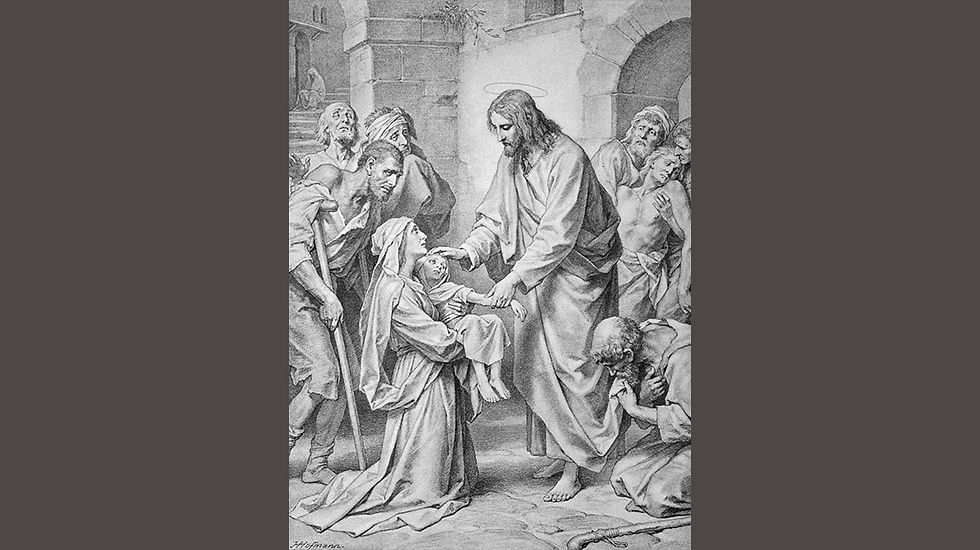
Sabbath Devotional: By Union of Feeling

The story of Ruth and Naomi is especially moving to me. After Naomi’s husband and two sons had died, she pleaded with her Moabite daughters-in-law to return to their own nation and families of origin to be taken care of. Orpah left, but Ruth, determined to remain by Naomi’s side, lovingly replied, “Whither thou goest, I will go and where thou lodgest, I will lodge: thy people shall be my people, and thy God my God” (Ruth 1:16). They left Moab and returned to Bethlehem where, because of her loyalty to her mother-in-law, Ruth married Boaz and as a Moabite outsider, became an ancestor of King David and, ultimately, Jesus Christ. The bond between these two women, an unlikely pair, illustrates a connection that goes far beyond obligation. It shows how selfless love, commitment, and devotion can knit two lives together through grief, hardship, and even differences in nationality and religious backgrounds.
How can we better center our religious experiences around connection and relationships? And how can we avoid experiencing faith as a strict set of do’s and don’ts and instead see it as a dynamic, heart-centered journey?
Being part of a faith community means we have a shared purpose, a sense of belonging and a mutual feeling of support. But what if we don’t feel this way? Can we show up for each other, be there for each other during hard times, and share in the successes of others even when we might have major differences in how we see the world? The word religion itself comes from the Latin root that can mean “to bind,” pointing to the idea of religion as relationship.
I want to have intimate loving exchanges with myself, my community and the divine. Christ has told us the first two great commandments, “Thou shalt love the Lord thy God with all thy heart, and with all thy soul, and with all thy mind. And the second is like unto it, Thou shalt love thy neighbour as thyself” (Matthew 22:37-39).
How can we feel like we belong? And how can we help those around us feel like they belong? I believe that these questions, and the many possible responses to them, strike at the heart of what it means to love God and our neighbor, which is God’s ultimate purpose.
One of the things I have had to drastically change about how I saw my church experience was shifting from a checklist mindset to looking for deep, authentic connections. In other words, I am not going to do things just to check a box or out of duty, but because I seek connection with God and with others. When I authentically connect — whether in my callings, ministering, serving my neighbors, attending the temple, in prayer or meditation, whatever that looks like, I feel a deeper sense of belonging.
Our covenants urge us to bear another' s burdens, mourn with those that mourn, and comfort those in need of comfort. I now see my covenants not as transactions, but as a sacred framework designed to bind our hearts to Jesus Christ and Heavenly Father and my neighbor.
Seeing the divinity in others is a powerful way to help us do this. One of my all-time favorite books is How to Know a Person by David Brooks. Here is a powerful quote from the book:
“I’ve come to believe that the quality of our lives and the health of our society depends, to a large degree, on how well we treat each other in the minute interactions of daily life. And all these different skills rest on one foundational skill: the ability to understand what another person is going through. There is one skill that lies at the heart of any healthy person, family, school, community organization, or society: the ability to see someone else deeply and make them feel seen — to accurately know another person, to let them feel valued, heard, and understood. That is at the heart of being a good person, the ultimate gift you can give to others and to yourself.”
Joseph Smith taught in Nauvoo, speaking to the sisters of the Relief Society, “By union of feeling we obtain pow’r with God.” By union of feeling — what a beautiful concept! He continued:
“When persons manifest the least kindness and love to me, O what pow’r it has over my mind. . . .
“. . . The nearer we get to our heavenly Father, the more we are dispos’d to look with compassion on perishing souls — [we feel that we want] to take them upon our shoulders and cast their sins behind our back. [My talk is intended for] all this Society — if you would have God have mercy on you, have mercy on one another.”
I always come back to this amazing, powerful quote. Kindness, compassion, empathy, mercy, overlooking differences — this is how I want to show up. This is how I feel God’s love. And this is how we become more like Jesus Christ.
Doctrine and Covenants 38:27 says, "Be one; and if ye are not one ye are not mine.” Being one, of course, does not mean that we all think the same, act the same, look the same, or vote the same. Being one means being one in purpose, one in Christ.
This can be really messy, complicated, and uncomfortable. But I that relationships are central to God's plan, serving as the way to learn patience, selflessness, and divine love. I’m so grateful for those who have looked past the differences we may have and have helped me feel loved and truly seen. I hope to do the same for others. As we look upward to God and outward to one another, I believe we can help ensure that everyone feels like they belong. In doing so, we become true disciples of Jesus Christ.
. . . . . . . .
Image: Ruth's Wise Choice, published by the Providence Lithograph Company, 1907
Julie Spilsbury is the faithful root director at Mormon Women for Ethical Government.