Sabbath Devotional: I Was Blind But Now I See
Updated: Sep 11

Recently, due to a medical issue, I spent over a week unable to see. Suddenly, and without warning, I lost a lot of vision in my right eye, and there was the potential that some — or all — of the loss might be permanent. As I worked with medical professionals to find a path forward, I left every visit reeling with the possible loss of activities and opportunities that only a few days before were part of my daily existence.
But then things got worse! On the post-surgery path to getting better, I was dropped, face down in the dark, unable to move or see. Sleep was elusive, distractions were few, and I was alone inside my head. Primed by worry about my eyes, my mind started wondering about the blindness in my soul. I replayed past decisions, ruminated on current problems, and wondered over and over if I had been clear or cloudy in my judgments. What had obstructed my spiritual vision? When did I feel like it had been accurate? I considered how much pride, anxiety, fear, and error I was prone to. It was truly a crucible for my soul.
I don’t think this was unnatural. The scriptures are replete with imagery connected to sight and blindness — using the physical ailment as a stand-in for a compromised spiritual state. The Lord repeatedly uses this metaphor to remind his people that by virtue of our fallen state, we see the world in corrupted ways, and seeing what is true and good, with clarity, is harder than we think.
In Isaiah 59 the prophet describes in great detail a civilization that has turned itself away from the Lord and lost its vision, explaining: “None calleth for justice, nor any pleadeth for truth: they trust in vanity, and speak lies; they conceive mischief, and bring forth iniquity” (v. 4). And, “The way of peace they know not; and there is no judgment in their goings: they have made them crooked paths: whosoever goeth therein shall not know peace” (v.8).
To illustrate just how compromised the children of Judah had become, he describes their lack of vision: “Therefore is judgment far from us, neither doth justice overtake us: We wait for light, but behold obscurity; for brightness, but we walk in darkness. We grope for the wall like the blind, and we grope as if we had no eyes: We stumble at noon day as in the night; we are in desolate places as dead men (v. 9-10). Collective sin has led to collective confusion and darkness.
When I read the words at the end of this passage, I imagine masses of people caught up in a scrum. Leaderless, pushed and pulled along by those around them, their anxiety rising as they realize they are losing peace, control, and safety and are being sent in directions they did not choose. Animal instincts take over, and, suddenly, the only imperative becomes survival. The words from Proverbs are suddenly less theoretical and very real: “Where there is no vision, the people perish” (Proverbs 29:18).
We all know exactly what this looks like from lived experience. Over the next few days, we will be marking the anniversary of two deeply tragic and violent national events. The attacks on 9/11 and the murder of Charlie Kirk caused enormous individual suffering, pulling people into vortexes of chaos and despair. In their aftermath, they continued to pull us along, warping and twisting our government and society in deeply negative ways, and setting off chain reactions of recrimination and pain. These included discrimination, anger, hatred, division, fractured relationships, and even war. In a panicked response to these events, we have often traded our individual freedoms for the illusion of collective security.
These were events with enormous blast radiuses, but, foundationally, both happened because at the center of the explosion were a few men who had allowed their vision to narrow to such a degree that they felt violence was the only solution available to them. They could no longer see anything beyond their hatred and were indifferent to the extended suffering that their own actions would cause. To varying degrees, we have all suffered with the consequences of their dark actions and have often become subject to our own responsive distortions of vision as a result. In situations like these, it is easy for us to feel trapped in this scrum and to feel despair.
But for the "children of the promise" there is another way to live. It is also foreshadowed at the end of chapter 59: “and the Redeemer shall come to Zion, and unto them that turn from transgression” (v. 20). Christ will come to redeem. Included in that redemption is the opportunity to see clearly, to find peace, and to chart a different path.
What is Christ offering us when he promises us a new ability to see? At the most foundational level, I believe he is giving us the vision necessary to help us fulfill the first two commandments — loving God with all our hearts and loving our neighbors like ourselves. The ability to see God clearly, and to understand his love, motives, and methods, is the equivalent of giving a North Star to sailors lost at sea. Suddenly, we have a way to navigate safely while all around us flounder. I believe he is also giving us the opportunity to see each other clearly and with deep love. (Even our enemies!) He knows that the best and most direct way to come to understand and feel our own divinity and worth is to fully recognize it in others. Christ is offering us the ability to truly learn to see —and therefore love — both our God and our neighbor.
That love has the potential to bear enormous and lasting fruit. It can make our time here on earth rich and give us the possibility to enjoy friendships, families, and societies all ordered very differently than those the world offers us. We have the opportunity to literally step out of the scrum and access transcendent peace. Again, we see what others simply cannot, as he sets before us the rough outline of a vision of Zion and invites us to bring our curiosity, courage, and talents and to work with him in building a safe, generous, and secure home.
Nowhere does Christ promise that we will be able to use the clarity of vision he grants us to control others or to create a world free of sin, error, and violence. These are the promises of a corrupted Christianity. The restored gospel clearly teaches that those who see only darkness will likely use their agency to disrupt others and cause pain. But the clarity of vision granted to the disciples of Christ will allow us to avoid seeing the world through their distortions and instead prepare us to offer innovative and courageous responses to sin and error. His followers will better understand how to absorb, mitigate, and contain the impact of sin, rather than amplify it. We will be instructed in the ways to use tragedy as a fertile soil in which we can plant good. We will become forceful visionaries of a better and more hopeful way forward.
This is the true power and possibility inherent in the gospel of Jesus Christ — that our whole hearts and minds will be transformed with this vision and that we will begin to see the world in completely different ways. He will lead us in new directions that we would not otherwise be able to discover. “And I will bring the blind by a way that they knew not; I will lead them in paths that they have not known: I will make darkness light before them, and crooked things straight. These things will I do unto them, and not forsake them” (Isaiah 42:16).
There is a price for this kind of vision. It requires us to eschew the things of the world. We must break open our hearts and commit to a new life in which we follow a path that is not always fully illuminated, knowing he will be true to his promise — offering just enough light to allow us to take the next step. Over the last few weeks, I have been praying regularly that my sight would be restored. But in recent days, I have added something new to those prayers. I have been asking for a truer and more Christlike sight in my heart and mind. Because in times where the blind lead the blind, we really only have two choices. We can abandon ourselves to the darkness, or we can turn to the Light of the World and see. He has not failed me in the past, and I am going to trust that he will illuminate my path.
. . . . . . . .
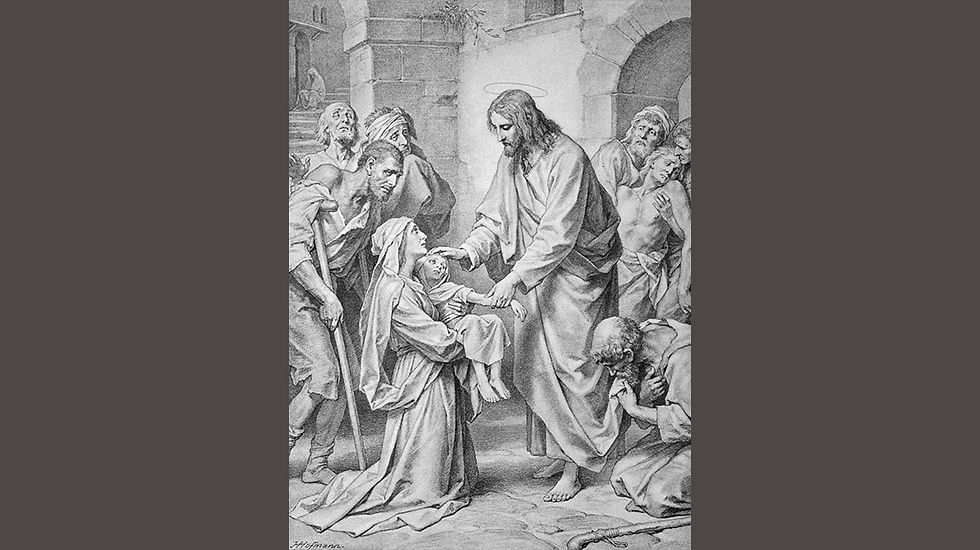
Art: Christ Healing the Blind by El Greco, around 1570
Jennifer Walker Thomas is a co-executive director at Mormon Women for Ethical Government.