
Sabbath Devotional: With Healing in His Wings
This year my family has had the unique opportunity to ponder what it means to be healed. Our 20-year-old son, Mattie, has profound disabilities that require full care, including cerebral palsy, epilepsy, and blindness. In 2024 he became very violent towards himself and my husband and me. For two years, it was a daily struggle to bathe him, dress him, feed him — and keep him and us safe. Many times, we were unsuccessful in that effort, and the physical scars borne by all three of us attest to the challenges we faced.
In April of this year, he injured himself so badly that he has never come home. He bounces back and forth between the main hospital and the adult inpatient psychiatric unit. Over the last 167 days, we have watched his dangerous behaviors increase and his health deteriorate. Words can’t adequately express how devastating it has been to see our special son tied to a bed and unable to control the rage being expressed by his body. With limited verbal abilities, we are left not truly knowing what he is thinking and feeling. We have struggled to accept seemingly never-ending shifts in our expectations.
I recognize that we live in a fallen world, and my son’s physical, emotional, and mental challenges may not be healed in this lifetime. While my mind knows this is true, my heart nonetheless is breaking. I mentally know my son’s body will likely remain broken, but my heart struggles to accept it. Healing for my son’s body may be elusive. Will my heart remain unhealed as well?
In the book of Malachi, we learn that Christ “the Sun of Righteousness [will] arise with healing in his wings” (4:2). In her book, The Temple Experience: Our Journey Towards Wholeness, Dr. Wendy Ulrich makes a fascinating distinction between being cured and being healed. To be cured is in essence to be fixed. It means that there is an end to the problem and a cure will return a person to their “previous state of wellness, which is usually what we long for.” Injuries are removed and the cured person rests their gratitude in the fact that the problem is now gone. I would love for my heart to be cured from the heartbreaking disappointments we’ve experienced, the extreme, unrelenting loneliness, and isolation of our situation, and the pain of witnessing such acute and dramatic suffering. I would like to pretend that none of it happened.
Healing, however, is a different process than being cured. Ulrich notes that it “involves a spiritual and emotional reweaving of our life story to incorporate, not merely remove, our injuries.” Christ’s healing — available even in the absence of a cure — presents an opportunity to mature into “a new state of deeper trust in God despite, not in the absence of, suffering.” With healing, gratitude is expressed for the ability we have had to change, drawing us to the needed power of the Atonement of Jesus Christ. In Christ in Every Hour, Anthony Sweat states, “The world can sometimes give us cures, but Christ can always give us wholeness. . . Christ heals us even if he does not cure us.” It is interesting that the Hebrew word for healing, “marpe”, is derived from the verb “rapha”, which means to make whole.
What are the struggles in your life for which you would like a cure but, perhaps, the way forward is healing? Have you been so focused waiting for a resolution that you have forgotten that you have the opportunity to be healed along the way? Do you find yourself pushing back on being healed because it means you are accepting that, for now, there is no cure? If you wrestle with these questions, you are not alone. I am wrestling with them at this very moment. Faithfully living our covenants while also letting go of our own reasonable and righteous expectations is a painful and difficult process.
The healing that Christ offers is readily available no matter where we are on our journey, but it does require that we are open to receive it. This year I have often felt aligned with Enoch when he “said unto the heavens: I will refuse to be comforted” (Moses 7:44). Opening my heart to being healed felt more reckless than hopeful. How can I seek peace when my son is in so much distress? But demanding a cure for me and my son has not been productive. Closing my heart to healing has left me spiritually famished.
It takes daily deliberate effort to let go of the cure and lean into healing — to recognize that the wholeness God can offer is different that the desired cure our mind so often clings to. Accepting “what is” is a start. As author and speaker Byron Katie said, “When you argue with reality, you lose, but only 100% of the time.” As you unclench your hands holding so tightly to what should have been, you will give your open heart the chance to accept and incorporate the path before you. Healing is within reach.
In Exodus 15:26, the verse in Hebrew ends with a beautiful titular designation for the Savior: Yahweh-Rapha or the Lord Who Heals. For those, like me, facing daunting life challenges, join me as I commit to walking the path of healing. It is vulnerable, it can feel uncomfortable, but this is one of the greatest gifts offered by the Savior. Truly Christ has “healing in his wings.”
. . . . . . . .
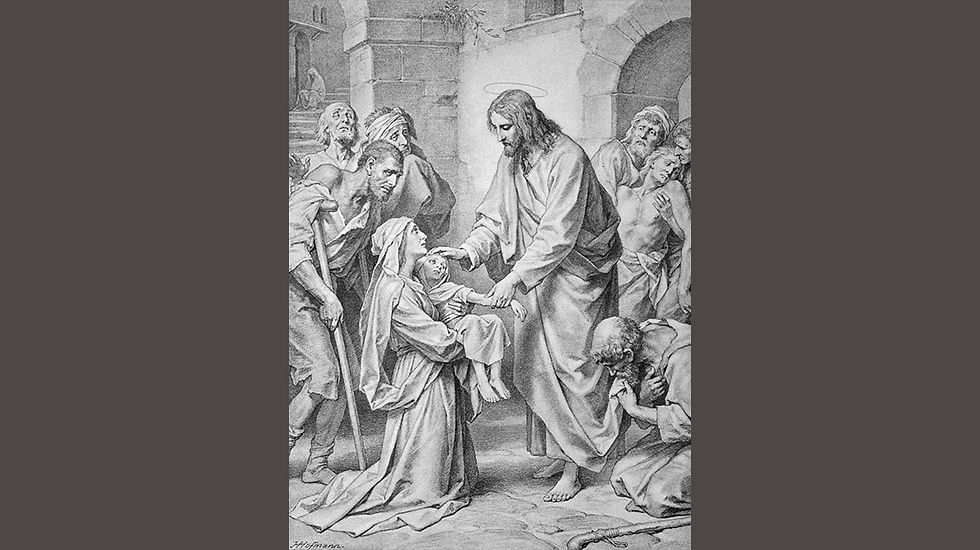
Image titled Christ Healing the Sick by Heinrich Hofmann around 1890-1893 (Wikimedia Commons)
Jane Andersen is the Arizona state director at Mormon Women for Ethical Government.


